Cancun Underwater Museum Scuba Diving Guide
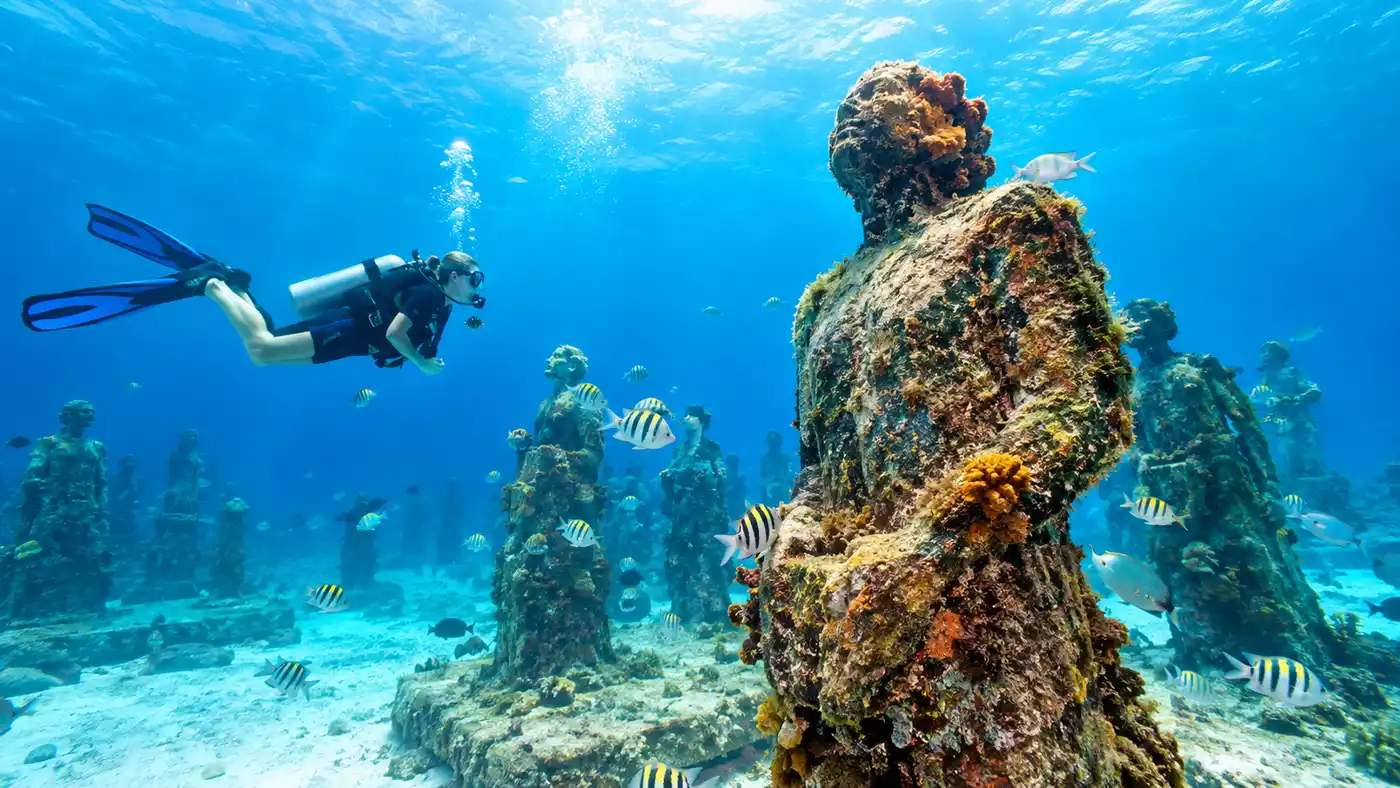
The first time you drop beneath the turquoise surface near Isla Mujeres, your eyes take a minute to process what is waiting on the seabed. You expect coral ridges and barrel sponges, but instead, an army of life-sized human figures stands silent in the sand, staring blankly toward the open sea. This is MUSA (Museo Subacuático de Arte), and booking a cancun underwater museum scuba diving trip is easily one of the strangest, most hauntingly beautiful things you can do with a tank on your back.
Most divers arrive in Quintana Roo hunting for classic reef walls or drift dives along deep channels. MUSA is something completely different. It was built deliberately as an artificial reef to lure crowds away from fragile natural coral beds. Over the years, mother nature has taken wild liberties with the concrete. Sponges sprout from stone foreheads, spiny lobsters crawl beneath concrete sofas, and schools of blue tang graze on mossy shoulders. Here is the realistic breakdown of how to dive it, what it costs, which gallery to book, and what you actually see once your bubbles clear.
Book your cancun scuba diving experience:
Understanding MUSA: Why There Are 500 Statues on the Ocean Floor
Back around 2008, the natural marine park around Cancun was getting pounded. Between devastating hurricanes and upwards of 750,000 tourists kicking fins into shallow reefs every single year, the local ecosystem was suffocating. Jaime González Cano, the marine park director at the time, teamed up with Roberto Díaz Abraham and British sculptor Jason deCaires Taylor. Their plan sounded a little crazy on paper: cast hundreds of real Mexican locals in pH-neutral marine cement, drop them onto barren sand shelves, and let the ocean do the rest.
The project officially launched in late 2009. It took heavy barges, specialized lifting cranes, and endless hours of underwater anchoring to sink the massive blocks. Because the cement contains no harmful chemicals and has a textured exterior, coral larvae attach to it with surprising speed. Ten years later, it is an active artificial habitat rather than a sterile art gallery.
A lot of people ask if it feels creepy down there. Honestly, it depends on the light. On bright sunny mornings when the Caribbean glows neon blue, it feels like exploring a forgotten sunken city. If an afternoon cloud deck rolls over and the light dims, swimming between rows of frozen stone faces will send a quick shiver down your wetsuit.
Pro tip: Book a morning boat leaving between 8:00 and 9:00 AM. The surface chop is usually much calmer around Isla Mujeres before midday, and the angled morning sunlight cuts right down to the sand for much better camera shots.
Salon Manchones vs Punta Nizuc: Where Can You Actually Scuba Dive?
Here is where a lot of travelers waste their money. The museum is split across multiple geographic zones, but there are only two main ones you will hear about: Salon Manchones and Punta Nizuc. If you want to do genuine scuba diving musa cancun trips, you must book Salon Manchones. Many dive counters along the Hotel Zone will sell you a ticket labeled vaguely as an art tour, only for you to discover you are headed to a snorkel spot.
Punta Nizuc sits right at the southern tip of the Cancun Hotel Zone. The water there averages 6 to 13 feet deep. Because it is so shallow, scuba diving is banned in that section to prevent divers from scraping the bottom or smashing statues with their tanks. Nizuc is strictly for snorkelers and glass-bottom boats.
Salon Manchones sits a couple miles offshore, just off the southern coast of Isla Mujeres. Here, the sandy bottom rests comfortably between 28 and 33 feet. That is the sweet spot for a relaxed, long bottom time on a single aluminum 80 tank. You will not burn through gas quickly at 30 feet, which makes this site perfect if you are getting back into the water after a break, or if you are trying beginner scuba diving in Cancun through a Discover Scuba program.
| Gallery / Site | Depth | Activity Type | Statue Count | Best For |
|---|---|---|---|---|
| Salon Manchones | 28 to 33 ft (8.5 to 10 m) | Scuba diving only | 450+ sculptures | Certified divers and DSD students |
| Punta Nizuc | 6 to 13 ft (2 to 4 m) | Snorkeling only | Around 30 sculptures | Non-swimmers, families, snorkelers |
| Chitales (Nearby reef) | 15 to 25 ft (4.5 to 7.5 m) | Scuba & snorkel | Natural coral | Second tank shallow dive |
The Iconic Sculptures: What You Will Actually Spot
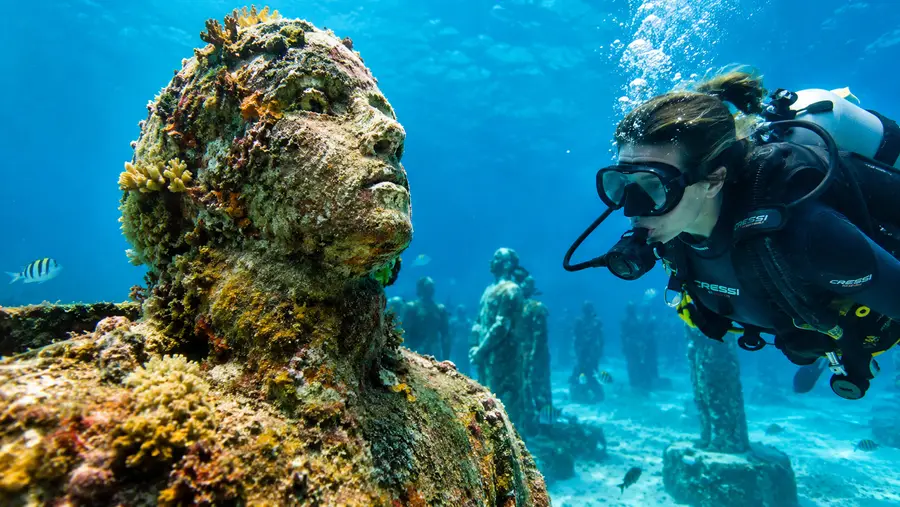
The main installation inside Salon Manchones is called The Silent Evolution. It covers around 4,500 square feet of ocean floor. Taylor cast real people from nearby Puerto Morelos and Cancun, ranging from local fishermen and carpenters to an 85-year-old nun and a little boy. They are gathered in a dense crowd, facing outward in protective rings. Over the years, staghorn corals have grafted onto their ears, and fire coral paints their arms in vivid orange hues.
Wandering away from the main crowd, you run into standalone pieces scattered across the white sand plain:
- The Anthropocene: A full-size 1968 Volkswagen Beetle shell specifically molded with internal crawlspaces where moray eels, juvenile fish, and lobsters nest.
- The Banker: Businessmen in suits with their heads buried deep in the seabed, complete with a tiny briefcase chained nearby.
- The Dream Collector: A tired man lying in an ornate bed surrounded by shelves stacked with sealed bottles containing real messages sent in from around the globe.
- Urban Reef: Two-story concrete houses engineered with micro-chambers that mimic natural reef crevices, providing shelter from predators.
Floating around the VW Beetle is surreal. Marine algae completely blankets the hood, and if you hover by the wheel wells, you can usually spot a spotted moray poking its head out. The sheer scale of the underwater museum cancun scuba diving footprint means you will not see every single statue on one dive. The guide typically navigates a slow loop around the perimeter before drifting you over the dense center cluster.
Book your cancun scuba diving experience:
Logistics, Costs, and Booking Your Underwater Museum Dive
Most dive shops do not sell the museum as a single-tank trip. Almost every operator pairs a dive at Manchones with a second dive at a nearby shallow natural reef, like Manchones Reef or Cuevones, so you get both art and natural wildlife on the same morning. If you want to check other shallow sites, take a look at our guide to the Cancun reef and wreck dive sites to see how they compare.
Prices generally run between $105 and $145 USD per certified diver for a standard two-tank morning outing. That typically includes your tanks, weights, boat ride, and a guide. Rental gear adds another $20 to $30 if you did not bring your own regulator and BCD. Do not forget the mandatory marine park bracelet fee. It costs about $6 to $12 USD, collected in cash at the marina dock, which goes directly to national park conservation efforts.
Note: Touching the sculptures is strictly prohibited. The park rangers hand out hefty fines to boat operators if guests touch the cement, because your hands wipe away tiny polyps and delicate bryozoans trying to establish coral colonies.
Before you run out and book, run through a few basic prep items to make sure you get the right trip:
- Verify the dive site: Double-check your confirmation voucher specifically names "Salon Manchones" so you do not get stuck on a surface-only snorkel boat.
- Pack a 3mm shorty or rashguard: The water stays warm, ranging from 78°F in February to 84°F in August, but a thin layer protects your skin against stray hydroid stings.
- Check your camera settings: Bring a red filter or adjust your white balance underwater. At 30 feet, red light fades out quickly, leaving photos washed out in murky cyan.
- Bring small cash: Cash is needed for the marina park fee and tip money for the boat crew and divemaster, who split tips at the end of the run.
Conditions, Currents, and Marine Life on the Statues
Diving conditions at MUSA are about as friendly as open-ocean diving gets. The current here is usually minimal to mild, drifting gently toward the north. You rarely have to kick hard against a stiff rip, which makes buoyancy control simple. Water visibility usually hovers around 50 to 80 feet, although heavy wind out of the north can churn up sand and drop it to 35 feet.
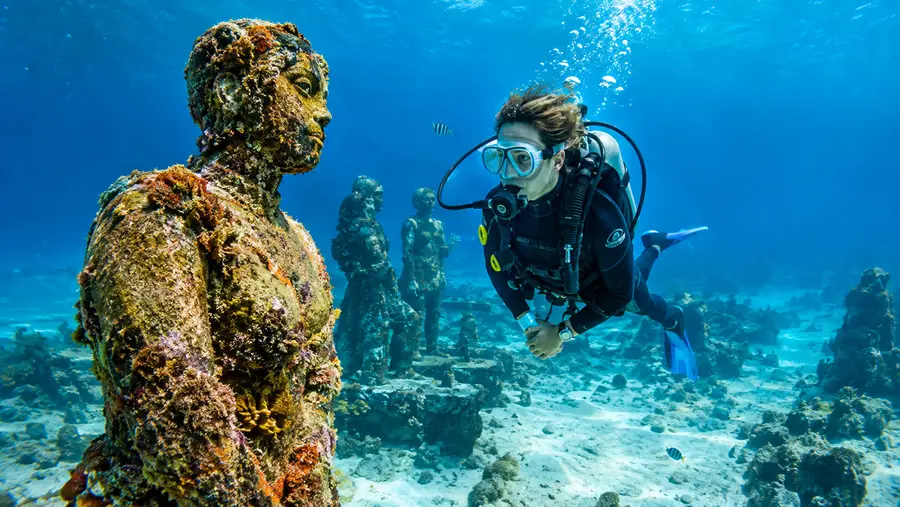
You might wonder if fish actually live among concrete statues. Yes, absolutely. It took a few years after the initial sinkings, but the statues now act as a bustling nursery. Angelfish slide vertically between the statues' legs, and schools of yellowtail snappers hang over the heads of the crowd like stationary clouds. Look closely in the sand around the pedestals. Southern stingrays love to bury themselves right next to the concrete footings, leaving only their golden eyes and tail barb exposed.
Keep your eyes pointed toward the blue water above the sand every so often. Green sea turtles cruise through the museum frequently, paddling casually between Isla Mujeres and the open Caribbean. They often drop down to nibble algae off the statues' shoulders, completely unbothered by hovering divers.
Frequently Asked Questions about cancun underwater museum scuba diving
Do I need an advanced certification to dive MUSA?
No, an Open Water certification is plenty. The maximum depth sits right around 30 to 33 feet on a sandy, flat seabed. Even uncertified travelers can dive it through a Discover Scuba Diving resort course.
Can non-certified beginners dive the underwater museum?
Yes. Many dive shops take beginner students here for their afternoon open-water training dive. You do a quick pool or beach session in the morning to learn mask clearing and regulator recovery, then head to Salon Manchones with an instructor holding your tank valve.
Can I snorkel the scuba diving museum instead?
You can snorkel over Salon Manchones, but you will be looking down from 30 feet above. You will clearly see the dark shapes and outlines, but you will not experience the eerie feeling of looking the statues straight in the eyes like you can on scuba.
Quick Reference
- Max depth: 30 to 33 feet (9 to 10 meters)
- Primary gallery for scuba: Salon Manchones
- Average two-tank tour cost: $105 to $145 USD
- Marine park entry fee: $6 to $12 USD cash
- Water temperature: 78°F to 84°F year-round
Book your cancun scuba diving experience:
The Bottom Line
Some salty divers dismiss MUSA as a tourist trap before they ever drop into the water. Sure, it is human-made and it gets plenty of hype on social media feeds, but swimming between hundreds of life-like statues covered in living sea fans is an unforgettable experience. It feels like an underwater time capsule. Grab your certification card, double-check that your boat heads to Manchones, and spend an hour drifting through one of the most unusual art exhibits on the planet.
Read more about cancun scuba diving.